Showing posts with label Culture. Show all posts

Saturday, September 19, 2015

Silence and Feeling Really Small

During my first week back as a student in the classroom, I realized that it was difficult for me to speak up in class. I second guessed whether to assert my voice. I wondered if I was worth being heard.

Where were those thoughts coming from? All throughout my academic life, I had been outspoken, unafraid of making mistakes. I knew I had something to contribute, and I had no shame in giving the wrong answer or mentioning something that might not be 100% relevant. Yet in the time I spent away from academia, something changed. My life experiences taught me to doubt myself. I received the subliminal message often enough that said, “Your voice doesn’t matter. Your concerns won’t be heard. You’re wasting your time if you speak up.” I guess I internalized it more than I expected, and it has been shaping my actions.

Digging deeper, I must ask myself about the source of that message. What were the circumstances that make me feel so powerless? The two times I’ve gone to the Financial Aid Office on campus, I’ve had physiological reactions—my heartrate increased, I wanted to run away, I struggled to express myself, and I anticipated being shrugged off. Thankfully, the people I spoke with both times were extremely gracious and helpful, but the question remains, “Why was my body reacting with fear when it faced an institution with power over my future opportunities?”

I think the answer reveals itself in a review of my interactions with institutions of power over the past five years. There was the time my parents and I were drugged and robbed in Quito. The police nearby did nothing. They were apathetic to my request for help to stop the thief who ran off with my backpack. Then there was the time I lost my passport on the way to the Ecuadorian immigration office. When I called the US embassy, they were too busy commemorating September 11 to help me. They basically said, “Figure it out from our website, and call us later.” Another time, I went to the embassy to drop off my overseas voter’s ballot. I was turned away. The guard refused me, a US citizen, entry to my country’s embassy for several hours. I thought that US citizens can never be refused access to a US consulate or embassy, but I must have been wrong. Maybe that only works for Jason Bourne.

Then there was the visa process and the ever-changing list of requirements. In five years, I had five different Ecuadorian visas. At one point, I almost had to travel to Peru and hope I could get a tourist visa. My sponsoring organization didn’t have its paperwork in the required format, and I was within days of my current visa expiring. For my most recent visa, I needed to be fingerprinted for a US police report. I went to the Ecuadorian criminal investigation service with the printed form so they could ink my prints onto the paper. However, the young detective insisted that I first be entered into the Ecuadorian system. He took my mug shot as if I was a criminal. Then he took extra time to digitally fingerprint me, making passes at me the whole time. Finally, he sent me over to his older coworker to fill out the form that had brought me there in the first place. I felt completely humiliated by the time I left.

I could go on. When I was hit by a car, people asked me if I wanted them to call an ambulance (wasn’t it a given?) The hospital refused me service until I presented proof of the ability to pay (what if I had been bleeding internally?) When I went to ensure the police filed their paperwork with the prosecutor’s office, I found out that they had written down the wrong license plate number. My case never went to court.

I almost missed my flight once because Ecuadorian immigration messed up my passport number on my previous entry into the country. I have yet to get through US immigration without a big X over my face, indicating that they think I’m suspicious.

Of all these events, can I point to one and say, “That’s the reason why I don’t speak up—why I shrink back from advocating for myself when I interact with large institutions?” No, it’s the cumulative effect of time and again feeling powerless. I spoke up at first. I challenged the US embassy on the way that guard treated me. Then the next elections came around and I experienced the same treatment. Should I shout louder? Should I rage against the injustices? It would just be noise. I’ve never seen anything happen because of my complaints.  I learned that it was easier to keep my head down and move forward, working harder and hoping that I could overcome the barriers in my way.

Now I’m living in the United States again. It’s not a system that rewards those who keep their heads down. I need to defend myself, and the people I speak to actually have some agency—they can challenge the system and make things happen. They make special exceptions for those who know how to advocate for themselves.

I’m trying to unlearn my silence. I’m trying to rebuild my confidence. My self-talk these days is, “Your voice matters. You won’t be punished for trying.” It’s hard, but I’m back in a society with a low power distance. I don’t sit at the bottom of a massive hierarchy in which everyone follows a prescribed process. I can approach those who make decisions, and it’s refreshing to have them listen to me. I know that I can’t instantaneously overcome my physiological reaction to certain situations, but I’m working on my mindset. Hopefully someday I will feel at ease once again in this country where I’m learning how to belong.

Tuesday, November 8, 2011

Ecuador Cities

When I was looking up a details about Cuenca for my last post, I came to a realization about how ridiculously long the official names of Ecuadorian cities are.
In truth, Cuenca is just a "short version" of the city's name.  Full name: Santa Ana de los cuatro rios de Cuenca.  Translation: Santa Ana of the Four Rivers of Cuenca.  Most cities in Ecuador are similar in keeping very long names.  For example, I live in San Juan de Cumbaya, right outside of San Francisco de Quito, and I helped on a medical brigade in Santo Domingo de los Tsachilas.  Notice the trend of including the name of the Catholic patron saints in the name of each city.  If that's not enough, most of the original city names had "Muy Noble y Muy Leal Ciudad de..." before their titles.  I find that ironic because "Very noble and loyal city" doesn't really fit with the whole revolution and independence from Spain part that happened a few years later.

Speaking of independence, Ecuador does have an independence day (August 10), but the real celebrations are on  the independence days of the three main cities of Ecuador (Guayaquil - October 9, Quito - May 24, and you already know Cuenca's).

As if Ecuador doesn't have enough holidays with its 4 official independence days, the days on which the principle cities were founded by the Spanish are often celebrated as well, albeit on a regional level.  Personally, I'm looking forward to Quito's founding on December 6, but there are also celebrations in Guayaquil on July 25, in Cuenca on April 12, and probably in some other cities on other dates as well.

This trend toward regionalism is important for understanding Ecuadorian culture.  You can tell just by the way a person talks whether they are from the coast (Guayaquil), Quito, Cuenca, or an indigenous group.  Quiteños call people from Guayaquil monos (monkeys), and the monos respond with something like "potato eaters."  Diet, agriculture, and industry change dramatically when one moves east from the Pacific Coast to the Andean mountain highlands to the Amazon jungle.  While Ecuador might be about the size of Colorado, the regional diversity noted in the distinctions between cities goes far beyond that which is noted in any one US state.

Monday, November 7, 2011

Happy [Cuencan] Independence Day

This last week Quito was dead.  As in, no traffic jams, very rare honking, and the street outside my apartment was eerily silent.  That was all thanks to a 5-day weekend in honor of Dia de los Difuntos (All Soul's Day on Nov. 2) and the Independence day of Cuenca, Ecuador on November 3, 1820.  While I decided to take the time to relax here in Quito and stay away from the huge crowds, I figure this is a good time to share some pictures from my trip to Cuenca last year for the celebration. Since my now apartment mate is from Cuenca, she invited me to visit her city and her family for the holiday.
Cristina and me at the Turi church above Cuenca
Turi Church

The highlight of my time in Cuenca was the burning of the castillos or "castles," which can best be described as 2-story towers of metal and paper machete riddled with firecrackers and other dangerous pyrotechnics.  This celebration happens in the evening in the central park, which was packed to the gills when I was there.


I think from those images you can get the picture--sparks flying everywhere.  The fun thing is that they set up the castillos all around the central park, and you never know which one they will light next.  So everyone crowds around one only to be part of the crowd running to the other when a different one is chosen.

Everyday in Cuenca during the holiday there were fairs, parades, and other celebrations.  I went to two fairs with Cristina and her family.  The first reminded me much of of a typical county fair, and the second was a lot like an arts and crafts show. 
This aint your typical Midwestern fair--llamas and alpaca are a prominent fixture.

As are guinea pigs
Mariachi band at the arts & crafts fair
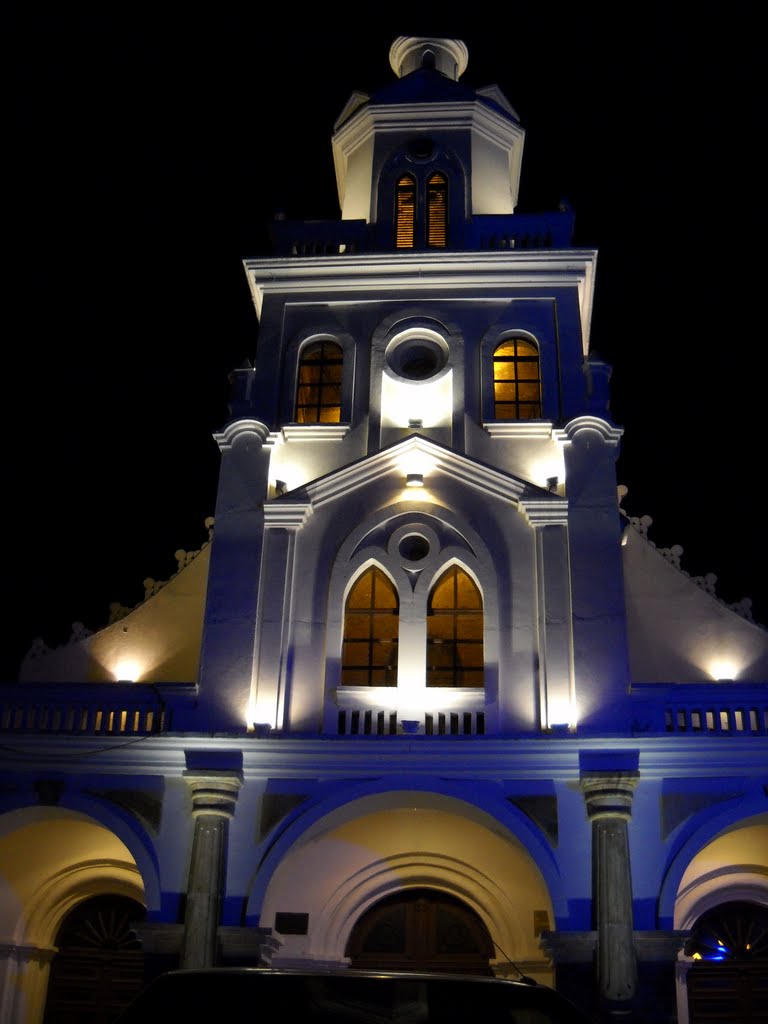
 Cuenca is a World Heritage Site because of its well-preserved colonial architecture.  A few evenings while we were waiting for events to start or driving around town, I captured these pictures:


Next time I get to visit Cuenca I hope to see more of these buildings, and maybe not just from the outside.  Another goal for the future is to go hiking in the Cajas National Park, which has hundreds of lagoons.  The closest I got was fishing along the roadside on the outskirts of Cajas, but even what I could see of the park from a distance was beautiful.

Wednesday, November 2, 2011

Have you ever?

Sometimes my life seems ridiculous.  As in, I ask myself, "did that really just happen?"  The thing is, many of the events that I now accept as "normal" are completely foreign to my upbringing in white, suburban, Midwest middle class America.  So...

Have You Ever...

Lived through an earthquake?  Just last Saturday--it was a 4.0 centered less than 10 miles away.

Had a guy hit on you by calling you fat?  Definitely--what other terms of endearment are there?

Cut the umbilical cord for a kitten?  Twice.  What else would you do if your apartment mate's cat suddenly started giving birth?  Go to the vet?  How absurd!
Mama "Missy" cat with the new kittens

When they were big enough to really be "cute"
Faked you were sleeping as soon as a guy asked if you spoke Spanish on a bus?  Of course!  Otherwise the next 2 questions would be "How long have you been in Ecuador? (polite conversation) and "Do you have a boyfriend?"  (what he really wanted to ask.)  Don't worry, I never actually sleep.  I usually keep my eyes half-open and am laughing on the inside as the guy tries to decide if he should ask again, just a little louder.  I think next time I'm going to start fake-snoring, just in case.

Had the airport police confiscate your still-valid ID only to have them send you to another branch of the police to get a police report that the ID was lost/stolen so that the same 1st branch of the police could issue a new ID?  Yes! (Did you even understand that illogical series of events?)  Oddly enough, everyone after that first police officer admitted that the whole process was pointless, but they insisted on following it.

Chased a llama?  Well, I wanted to pet it...
Worn sunscreen everyday, 365 days a year?  Almost yes--otherwise I'd be burned in about 15 minutes.  Direct sun on the equator + less atmosphere in the mountains = higher chances of skin cancer.  Not going to take the risk.

Eaten a guinea pig?  Sorry to anyone who has one as a pet, but it's just a fact of life in Ecuador.  So yes, I have.
Señor Cuy
Run away from firecrackers flying into the crowd from a burning "crazy cow" that a nonchalant guy was carrying?  Um, yeah.  I think my friends here are still laughing at me for that.  Vacas locas are part of any real fiesta.

So for anyone who thinks life in Ecuador is just like life in the US--think again!

Tuesday, November 1, 2011

No Typical Bus Ride

Climbing onto a bus in Ecuador is always an adventure.  You never know what might happen in the next few minutes, or hours, of your time in that enclosed space.  There's always the cute little babies on their mother's laps--cooing, making faces, and sometimes crying.  Then there are the school children dressed in their uniforms, which come in every color of the rainbow (although mainly blue, red, black, and yellow).  For girls the uniform is usually a short pleated skirt with knee-high socks and some schools make the boys wear full suits.  I always am amused by the 10-year-old boys who look like they just came out of a board meeting.

Beyond the normal--the people sitting or standing, waiting to get home--there are sometimes unusual events that just make me want to laugh.

Street vendors aren't the only informal business feature of Ecuador.  There are also what can best be described as "bus vendors."  These people wait at the major bus stops to ride a bus to the next major stop, and since my route to Quito is a relatively uninterrupted 20 minutes long with few stops and distractions, it is a favorite for bus vendors.  You might be able to best understand the experience as a live, moving infomercial.  Here's one of my favorites:
Guy gets on bus and introduces himself, "Sorry for the inconvenience or for making you uncomfortable.  Some of you might not want to listen to me, but thanks for listening anyway [as if we have a choice...talk about a captive audience].  Many youth my age are stuck in drugs and alcohol and gangs.  I used to do that once, but now I've turned my life around and am working in a dignified manner to feed my wife and 9 children [okay, so maybe only 2 kids]."
"As you all know, we Ecuadorians love greasy fast food--hamburgers, french fries, hot dogs, etc.  You know it's bad for your health, but did you know that it can cause hepatitis A, hepatitis B, prostate cancer, and many other diseases?"  [insert here a long, non-scientific explanation of the connection between hamburgers and prostate cancer].
Now for the kicker:
"Do not worry, today I am selling this bag of tea made from natural sources that will clean out all the grease and fat and save you from hepatitis and prostate cancer.  For the low price of 50 cents [you can miraculously buy a healthy life]."
Good thing I don't get my medical advice from bus vendors.

Some other good ones:

Last Friday I was headed up to Quito when traffic came to a standstill right before "la bomba" in Miravalle.  Let's just say that we were 5 minutes into a 20 minute ride.  After waiting 10 minutes and not moving an inch, the bus driver decided to make a 3-point, ahem, 9-point turn across 4 lanes of traffic.  We returned from whence we came and then took a cobblestone street up to the highway connection.  All the way back down the hill the cobrador flailed his arms anytime another bus passed, trying to get them to turn around.  The question is--since there are no cross streets on that stretch, how were they going to turn around?  Another 7 buses doing 9-point turns?  That's something I'd like to see.

One weekday on my way to work I was riding the Ecovia line.  A little girl, perhaps 5 years old was sitting right by me on her mom's lap.  She looked at me for a while and then all of a sudden she started telling her mom in English, "I love you. I love you. I love you."  She paused for a second and then asked her mom in Spanish, "What does that mean?"  Well, I'm glad the presence of a gringa caused that little girl to express her love for her mama, even if she didn't know what she was saying in my language.

That's Ecuador for you--rarely a dull moment on a bus.

Friday, September 23, 2011

Mas Fruta

Yes, that means "more fruit" for those who aren't 100% confident of their Spanish.  Even for those who do know Spanish from some other parts of the world, some of the names for the following fruits might still leave you stumped.  But that's what's unique about Andean fruit--though they might be found elsewhere, many of these fruits, like uvillas, are native to Ecuador, Colombia, and sometimes Peru.

Naranjilla (Solanum quitoense) - the Latin name for this fruit actually means "from Quito," prooving that this is definitely an Ecuadorian fruit.  I actually couldn't find an English name for it (little orange??), but naranjilla, commonly used for juice here, has gone from a "what is this" fruit to one of my favorites!  I'll take it as juice, icecream, a shake, whatever!

Tomate de Arbol (tamarillo) - another native of the region, this fruit is now cultivated as far away as Australia and New Zealand.  Although tamarillo is often used for juice, it's great as a snack - just cut it in half and scoop out the center.  Or you can cut a hole at the top and squeeze out the insides :).  I've also heard that heating the fruit and eating it with honey has medicinal effects on a sore throat.  I'm definitely trying that next time I'm sick!

Pitahaya (yellow dragonfruit) -think "sweet to the 10th power."  I can't say this is my favorite fruit, even though I have a huge sweet tooth.  However, every once in a while I like to cut a pitahaya open and scoop out the juicy flesh and seeds for an afternoon snack.
 
Uvilla (cape gooseberry or Inca berry) - the only time I've eaten fresh uvillas was when hiking with friend.  We came across some growing wild and ate them along the way.  However, my favorite Ecuadorian granola uses dried uvillas as a tangy addition to the mix.  Native to the Andean mountain region, this fruit grows wild and isn't as common to find in a fruit market as the rest. In reality, it looks a lot like a small cherry tomato growing in a pod that refuses to take on any color other than orange.

Guanabana (soursop) - I've never had this fruit prepared in any other way than as a juice, so I'd call that standard fare for guanabana.  However, when I was out on the coast a couple months ago, several people had soursop growing in their backyard, so here's the evidence:

Tuesday, September 13, 2011

Fruta!

One of the most common questions I get from people back home is--what's the food like over there?  Someday I promise to post pictures of some of the most common main dishes and give an explanation of the general diet, but I'll start off with fruit...

One fruit I really miss from the US is blueberries, which I have yet to find in Ecuador, but besides that, we have all the common fruits you would find in the US--apples, oranges, blackberries, bananas (some of your bananas might actually be from Ecuador), mangos, mandarin oranges (in season now!), plums, and strawberries (there is no season--they are produced all year round!).

On top of those fruits, there are many others that are different, strange, and downright weird-looking.  But hey, as long as they taste good, right?  So here's a few of those random fruits, and I'll tell you about the rest next week.

Achotillo (Rambutan) - I was first introduced to this fruit in Nicaragua, where it's called mamon chino.  The bright red prickly skin is cut or bit open to reveal a sweet, white flesh surrounding a large pit.  When I first tried this fruit, it would take me a full 15 minutes to pry the flesh off of the pit by rolling it around in my mouth.  I'm sure my Latino friends got a kick out of watching me as a gringa try to master the art of eating achotillo.

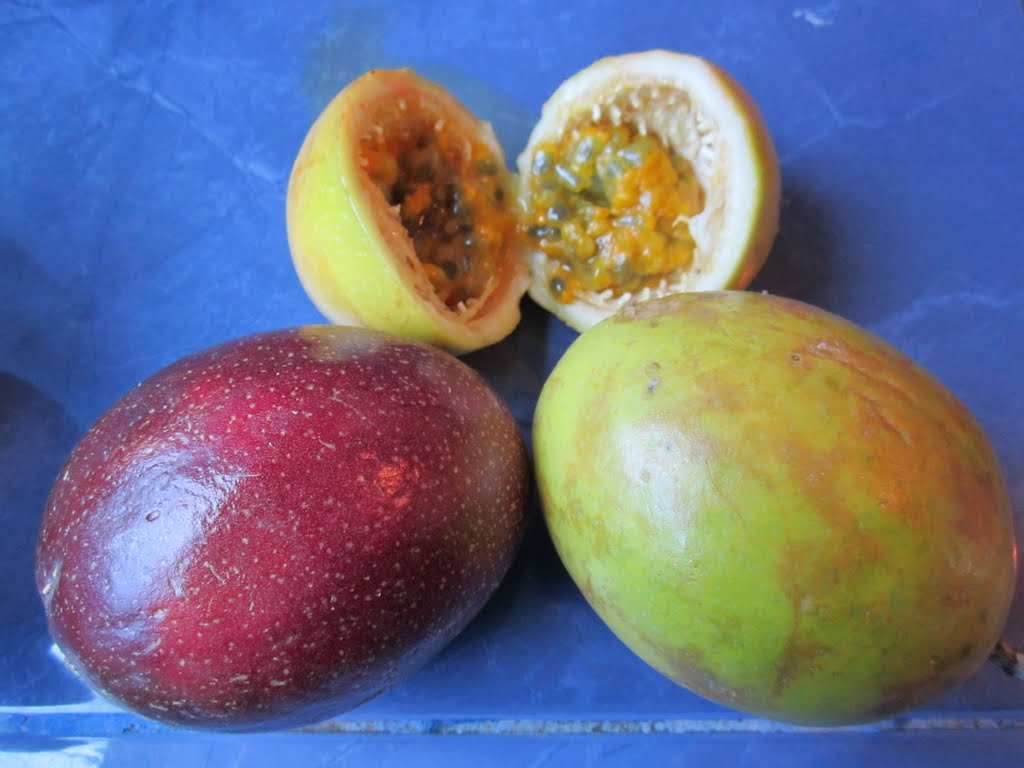
Taxo (Banana passionfruit) - it wasn't until some Cuban friends recognized this fruit from eating it in their homeland that I dared to try it.  From the outside, taxo could easily be mistaken for a small, rounded banana, but once you cut it open, there are hundreds of juicy pods surrounding bitter seeds.  The best way to eat it is in a batido (milkshake), but if you aren't careful and accidentally blend the seeds, it becomes a bitter drink.

Noni - I'd heard about the medicinal properties of this fruit before, but I didn't know it grew in Ecuador until a businessperson offered me some fruit from her backyard.  When we picked it off the tree (pictured below), the fruit was still yellow-green, but within a day it turned completely white.  I still don't know how to prepare or eat it (it's pretty bitter), but hey, maybe eating a few of these fruits lengthened my life :)

Maracuya (passion fruit) - after living in Central America, I absolutely love maracuya.  It's one of those fruits that's intensely acidic and is best as a juice with lots of sugar, but I would even eat it straight out of the shell.  Even when I'm back in the US, I can often find the juice in Salvadorean pupusa restaurants.  If I had to guess, this is probably the fruit that I'll mot likely be able to eat for the rest of my life.


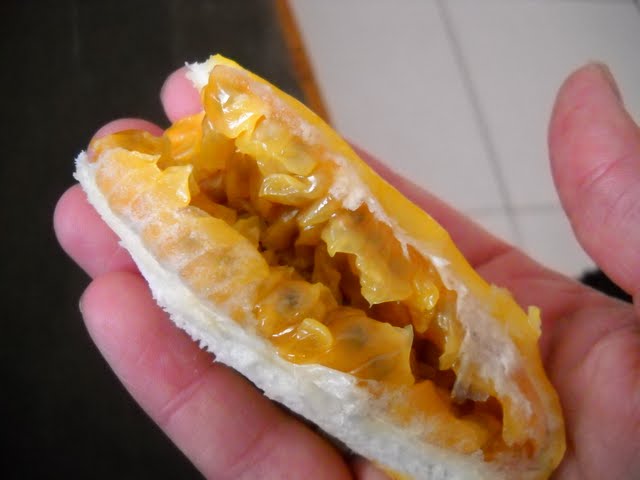
Granadilla (also called passion fruit) - of the unusual fruits of Ecuador, this is the one that I tend to buy the most.  Although it looks a little like maracuya, granadilla is anything but acidic or sour.  To eat it, you crack open the outer yellow-orange shell, then peel away the skin, and inside there are hundreds of black seed surrounded by grey capsules of sweet juice.  It's a "crunchy" fruit due to the seeds which are eaten with the juice, and since the best way to eat it is by slurping out of the shell, it's also a noisy fruit to eat.  But the noise and possible mess are all worth it.

So there are a few fruits for your culinary enjoyment, with more to come in a future post.

Thursday, June 2, 2011

Children have Rights to be Free

Yesterday was Children's Day (Día del Niño) here in Ecuador and in many other parts of the world.  When I turned on the radio in the morning, I heard commentaries about the need for better access to medical care, less child labor, and better education.  That's true not only here in Ecuador, but also in almost every country around the world.  While the tradition here in Ecuador is to give children a gift in their families and a special celebration in their school on this day, there are other children who worked yesterday just to have some money to buy food.  Most of those children weren't in school to participate in some special celebration.

Everyday here in Ecuador I see children who don't have the same advantages I had growing up.  Most days as I ride the bus, there are young boys and girls pushing their way through the crowded bus to sell gum or candy to commuters.  I live just up the hill from a large public high school, where two separate groups of students receive their education each weekday.  There is an additional Saturday school group and a once-a-month distance-learning school.  Sharing that space with so many other students cuts down on the time those students spend in the classroom learning.  And they are the lucky ones.  In July outside some schools, one can see parents literally camped out to reserve a cupo or space so that their son or daughter can attend that public school when it begins classes in August.  If the parent isn't successful, that child misses a year of school.

While this post might seem pessimistic, I'd like to end on a hopeful note.  First, by celebrating days like yesterday and focusing on the needs of children, we raise awareness and can work to improve the opportunities for each child.  Second, progress is being made, albeit slowly.  Ecuador is actively working to end child labor for children under 15 years of age, and in recent months, I've seen much more enforcement  of labor laws in this country.  And third, part of my work in business development is to support job creation.  As parents are able to earn a fair wage and support their families, they are able to send their children to school instead of sending them to sell gum on the streets.

Last night as I listened to some music, a bitter sweet song that has become one of my favorites came up on my playlist.  K'Naan asks in his song Fatima, "Why do we say that the children have rights to be free?"  He questions that statement because in his personal experience it wasn't always true.

I would respond that we must continue saying that children have rights to be free because the moment we stop saying that, we give in to those who would take freedom away.  But if we keep that right to be free in our mind even when it's not Children's Day, we remember our responsibility to ensure that right is respected for all children.

Wednesday, June 1, 2011

24 de Mayo

On May 24, 1822, General Jose Antonio de Sucre led Ecuadorian liberation forces in the Battle of Pichincha, which established Quito's independence.  In effect, this was the final step to liberating all of the territory of the Real Audiencia de Quito, basically a swath of land from Guayaquil on the Pacific Coast  to present-day Belen, Brazil at the mouth of the Amazon on the Atlantic Coast, including all of present-day Ecuador along with parts of Peru, Colombia, and Brazil.

So, you might ask, why does a battle 189 years ago matter?  Because it's a holiday here in Ecuador!  Actually, due to the politics of the current Ecuadorian government, all national holidays that fall midweek are moved to either Monday or Friday, resulting in a long weekend.  In this case, last Friday was the holiday, and I took advantage of the day off to climb through the site of that ancient battle--the slopes of Volcano Pichincha.  I had mentioned my climb earlier in May to my friend Leo, and he wanted to tackle the mountain as well.  We conquered the summit in about 2 hours, 45 minutes after a slight detour due to the intense fog.  My favorite part was finally seeing snowfall.  Yep, I missed snow all winter, but on May 27, I finally got to experience flurry showers...and the accompanying almost-frozen fingers!  It was great to tackle that summit again, and the next day I attempted a new summit, Pasochoa, with some friends.  We had to turn back because of fog and low visibility, but hopefully in August we can make the top.  More on that story (hint: pictures) at a later point.

Since I'm talking about 24 de Mayo, I want to end by sharing a little about how that battle and other events from hundreds of years ago shape present-day Ecuador.
1) The Sucre: Until dollarization in 2000, Ecuador's currency was the sucre, named after Jose Antonio de Sucre, whose face showed up on the 5 sucre note.
2) Border disputes: In 1822, the territory ruled from Quito extended from ocean to ocean and dwarfed present-day Ecuador.  Over the years, bitter battles and disputes with Colombia, Brazil, and Peru have shrunk the borders of this country, where hostility still remains.  Since the last border war, the Cenepa War with Peru, came in 1995, some Ecuadorians still harbor hard feelings against their neighbor to the southeast.

Monday, May 23, 2011

Vota Si? Vota No?


May 7 was Voting Day here in Ecuador.  Actually, it was a referendum, so there were 10 questions for which a person could elect to vote Sí or No.  A lot of attention was given to the question of whether the famous Quito Bull Run and the historical Andean cock fighting should continue.  However, the weightiest questions centered on the potential restructuring of the judicial system and regulation of the media.  While I could give an analysis of the impact of these decisions, suffice it to say that I think this referendum will have extensive implications for this country.

However, since I didn’t participate directly in the election, it was an opportunity for me to focus more on the concept of suffrage, especially as it relates to democracy.  One interesting aspect of voting here in Ecuador is that it is mandatory, and not just for citizens.  A friend who has lived here for 2 years had to vote, and so did the many Cubans, Venezuelans, and Colombians who have obtained Ecuadorian permanent residency.  Not voting results in a $30 fine, so most people show up and vote even if they don’t know anything about the questions.

Is that good or bad?  I’ve debated the consequences of mandatory voting with several friends, and it’s not as clear-cut a decision as one might think.  Democracy is by definition rule by the people, so how can the people’s preference be ascertained if only a minority vote?  Popular opinion should be the rule, and the will of the general public should always be the guideline, right?  At the same time, does someone who is uneducated on the topic know what is in her best interest?  Can someone who is ignorant of the consequences of a vote really make an informed decision on matters of lasting consequence?  Unfortunately, as Mancur Olson pointed out in Power and Prosperity, the average citizen does not benefit proportionately for researching how he should vote.  It is much easier to free ride on the research of others because one vote will have little effect.  But if too many people choose to free ride, the uninformed voter will win the day and might later recant the decision.

So, is it better to mandate that everyone vote, or is it better to allow each person the free choice of whether to participate in an election?  Maybe we should take a vote on that one.

Sunday, May 1, 2011

Waterfalls


For the past two weeks in Ecuador it has been raining.  I don’t mean the cloudy-all-day-no-sun rain, but “winter” aka the rainy season, Ecuador style.  Every morning I wake up to a brilliant sun and any clouds that existed at 6am are burned off by 8am when I’m headed to the bus.  To an outsider, it would appear that rain showers would be impossible.  But between noon and 1pm, without fail, it starts raining—sometimes with a downpour and thunder and sometimes even with hail.  If you ever want an example of the phrase “appearances are deceptive,” I’ve got a great one—Ecuador weather.

The upshot of all this is that more rain=larger, faster rivers=better waterfalls.  Last weekend, during Easter break I spent some time with a family in Pintag, and we hiked through a river canyon to several spectacular waterfalls.  From now on, when people talk about the beauty of Ecuador, these waterfalls will be one of the things I think of, along with the volcanoes, jungle, and patchwork fields on mountainsides.  So, come along for a picture tour of the hike out to the waterfalls.

And not to overlook my countdown...
1 day until my parents arrive
65 days 'til I meet a new niece or nephew in Michigan!

Now let the waterfall tour begin...
Hiking down into the river valley

The adventurers - on a more well-beaten trail

The first waterfall - more of an occasional, rainy season addition to the river below

Another small waterfall

Under the waterfall (pretending that we like the ice cold water!)


Valeria and her sister stand on a tree beside the river


We came across some horses on our hike, and someone convinced me to mount this one bareback

First river crossing (the second was up to my waist!)

Wilson went fishing for river trout every chance we got along the way.

The first major waterfall
Second major waterfall

The Waterfall!  We could hear it a 1/2 mile away!

Lunch break at 2pm on the return journey.

Looking down on the largest waterfall in the distance.  It started raining right after lunch, so we opted to hike straight up the canyon wall, with some bouldering and scrambling included.  We arrived back at the house 6 hours after we left and completely exhausted.